By Suzie Thoraval
The simple perspective shift that makes ideas easier to support and decisions easier to make
“Seek first to understand, then to be understood.”
When I led risk inside organisations, I learned an important lesson about engagement and influence. To other leaders in the organisation, risk management was often perceived as something additional. Important, perhaps, but not urgent.
If I spoke about risk in technical or compliance language, a spreadsheet to be filled out because they had to, it rarely gained traction.
When I spoke about what they were worried about, what could derail their priorities and what would help them deliver on their goals with fewer surprises, the conversation changed.
Risk management became a way to protect outcomes and focus effort. People could see what was in it for them (WIIFM).
I often see capable leaders become frustrated when others don’t seem to understand the value of something they are trying to move forward.
When we shift the focus from what we want to do to what will make an idea meaningful for the other person, there’s a shift. The conversation becomes easier. The message lands differently.
That perspective shift can be a turning point for leaders seeking to influence by using adaptive stability.
Why WIIFM matters more than ever
In complex environments, people are making constant decisions about where to place their scarce time and attention. Every request or proposal is filtered through a simple internal question: how does this affect me and what I am trying to get done?
This is not selfishness. It is how people manage risk, workload and expectations.
Research on motivation shows people are more likely to engage when they can see how an action connects to their own goals and sense of progress. Emotional intelligence research highlights perspective-taking as a core leadership capability.
When people can see what’s relevant for them, they pay attention.
In uncertain environments where people are managing constant competing priorities, limited resources and heightened scrutiny an unclear reason to care can quickly feel like extra work or additional risk.
In that situation, it feels better to say no rather than agree to the extra burden. But when relevance to them (or WIIFM) is clear, people are far more willing to engage and incorporate.
Connecting WIIFM to adaptive stability
One of the core ideas in adaptive stability is helping people maintain clarity and confidence while navigating change and uncertainty.
I often think of influencing as building a bridge. On one side sits your idea, proposal or change. On the other sits the other person’s priorities, pressures and goals.
WIIFM is the bridge between the two. It asks us to translate what we want to do into terms that make sense and feel useful from the other person’s side of the table.
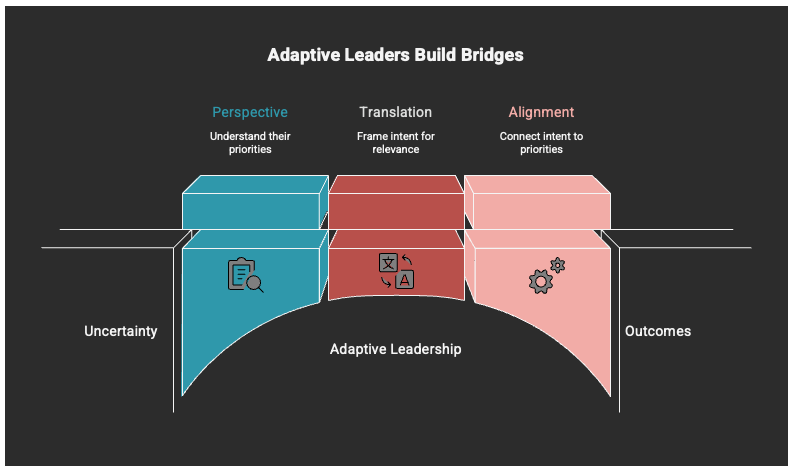
When leaders take time to understand what matters to others and express ideas in ways that connect with those priorities, they create alignment.
People know why something matters and where they stand. That clarity supports steadier decision-making and more constructive collaboration.
This sits across three key leadership capabilities that are core to adaptive stability:
Mindset - by using curiosity and seeing it from another person’s context, leaders shift from focusing only on their own reasons to do something to considering the pressures and goals of others.
Flexibility - the objective remains consistent, yet the framing changes depending on who is listening. A proposal might be expressed in terms of risk reduction, efficiency, reputation or team wellbeing depending on what’s important to the audience.
Resilience -when leaders encounter resistance, they stay curious rather than defensive. They explore what might be driving hesitation and adjust the conversation so it speaks to what matters most.
When these capabilities are present, alignment forms more easily and conversations move forward with less friction.
The reality of competing perspectives
Emeritus Professor Gillian Triggs AC’s time leading the Australian Human Rights Commission offers a useful example of how complex this work can be.
Her role required engaging across a wide and often contested landscape. Government, community groups, legal stakeholders and the broader public were not always looking at issues through the same lens.
Each group carried its own expectations, pressures and concerns. What felt essential and urgent to one group could feel confronting or inconvenient to another.
What stood out in her leadership was the steady effort to connect complex and sometimes uncomfortable issues to what they meant for people and institutions in practical terms.
Conversations were linked to the rule of law, institutional integrity and Australia’s international standing. She worked to help stakeholders understand why these issues mattered and how they connected to their responsibilities.
That did not mean everyone agreed. In roles that sit at the intersection of law, policy and public debate, full alignment is rarely possible. The work of leadership is not about achieving universal approval. It is about continuing to engage and connect the work to what matters for those involved.
When people can see how an issue connects to their role or the outcomes they care about, they are more willing to engage constructively. When that connection is not clear, even important work can be set aside.

What WIIFM thinking looks like day to day
This approach is a discipline of attention and curiosity. Before putting forward an idea, effective leaders pause to consider the other person’s context:
What are they trying to deliver?
What pressures are they under?
How might this help them succeed?
They stay open to the possibility that some stakeholders may not yet see a clear benefit. When that happens, the task is to understand what may be missing from the way the idea has been expressed.
Over time, this becomes a habit. Conversations feel more constructive because they begin from shared understanding rather than assumption. Influence grows because relevance is clear.
Before your next important conversation, ask yourself: if I were sitting on the other side of the table, what would I need to know for this to be worth my time and energy?
