By Suzie Thoraval
Aligning the team will help stop pressure pulling it apart
“The strength of the team is each individual member. The strength of each member is the team.”
I have been watching The Last Dance, the documentary about basketball legend Michael Jordan and the Chicago Bulls. It is a powerful reminder that talent alone does not create a great team. Even extraordinary performers need shared purpose, role clarity and a way of working together under pressure.
The pressure to move quickly
When a new leader steps into an organisation with serious problems, there is often enormous pressure to move quickly.
External stakeholders may be asking hard questions. Some issues may feel like they are on fire. There may be legacy problems to fix, confidence to rebuild and a reform agenda that cannot wait.
In that environment, it makes sense that the leader focuses first on stabilising the organisation. They may be thinking, “If we do not deal with these pressing issues now, we may not have an organisation strong enough to reform later.”
So they bring in strong executives. The leader has a clear sense of the reform that needs to happen. They focus on getting things moving.
But clarity in the leader’s mind is not the same as shared clarity across the team.
When the tension starts
Over time, the gaps can start to show. Executives may disagree about roles and responsibilities. Some may not yet be on board with the direction. Others may support it in principle, but have different views about what it means in practice. Decisions are questioned. People feel left out of conversations, or pulled into work that does not belong to them.
On the surface, this can look like personality conflict. Often, it is a sign that something is unclear. The tension may be the team demonstrating that they have not yet built enough shared clarity, trust or commitment to carry this reform together.
Stabilise first
This is where the situation becomes difficult. The leader may feel they cannot afford the time needed to step back and work with the team. The external pressures are real. Stakeholders may need reassurance. Risks may need to be contained. Decisions may need to be made quickly.
But if the executive team is unclear, divided or working from different assumptions, those urgent issues become harder to manage. The leader can end up carrying too much alone, becoming the point of escalation for every disagreement and every unclear decision.
So the question is not whether the leader should focus on the external pressures or the internal team. The question is: what does this team need to agree on now, so we can deal with the urgent issues without pulling in different directions?
Why storming is not always a bad sign
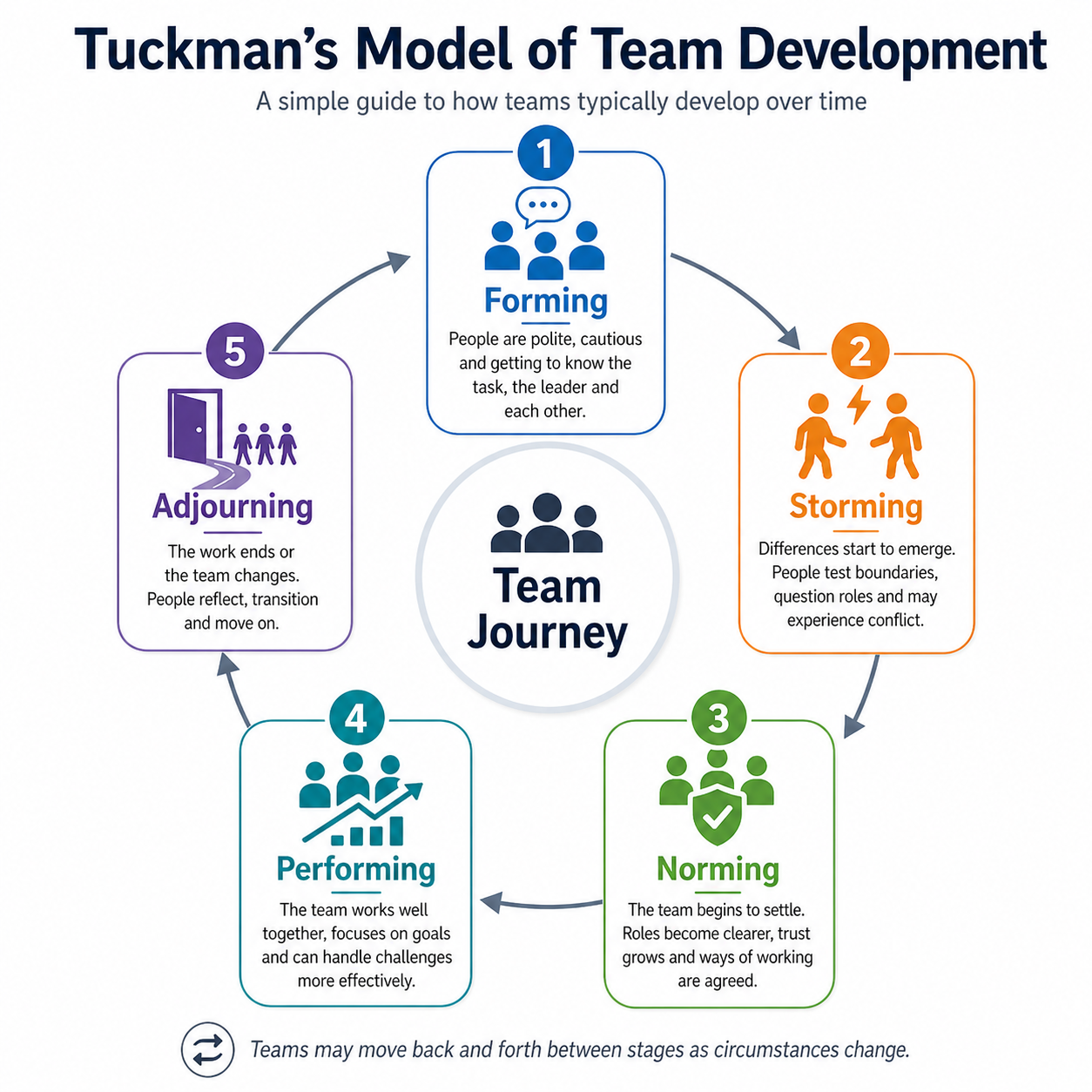
When clients are facing these kinds of issues, I find Tuckman’s stages of team development a helpful lens. New teams do not usually become high performing teams right away even if all the individuals have talent and dedication.
New teams often move from forming, where people are polite and finding their feet, into storming, where differences, assumptions and tensions begin to surface.
Storming is not automatically a bad sign. In many ways, it means the real work has begun. The risk is that leaders misread it. They may keep pushing for progress without stopping to clarify what the team needs from each other. Or they may try to smooth over the tension too quickly because conflict feels uncomfortable.
A better approach may be to slow down just enough to find clarity. The urgent issues still need attention. But they will be easier to handle if the team knows what matters most, who owns what, and how decisions will be made.
It is part of creating the leadership conditions needed to deal with them well.
Christine Nixon at Victoria Police
Years ago, I attended a women in leadership course and was inspired by Christine Nixon's insight. What stayed with me was not only that she had been the first woman to lead Victoria Police. It was the way she spoke about leadership in complex, high-pressure environments.
When she became Chief Commissioner in 2001, she stepped into one of the most scrutinised public leadership roles in Victoria. She was also leading change in a culture that had been shaped over many years. Many senior people had worked in particular ways for a long time, and that can make reform especially difficult.
It is one thing to set a new direction. It is another to bring people with you when they have established habits, loyalties, assumptions and ways of working.
For me, her example is a reminder that the early work of reform is often less visible than the public announcements or strategy documents. It is the work of building shared clarity, trust and purpose around the table, so the people leading the change can actually carry it together.
Staying steady while the pressure is high
This behaviour signals adaptive stability. In uncertain and pressured environments, leaders need to create enough stability for people to think clearly, while still keeping the organisation moving.
That means noticing when urgency is creating friction. It means being flexible enough to adjust the pace and process. It means building team resilience so people can have honest conversations without the team starting to fragment.
A group of capable executives does not automatically become a strong executive team. Talent matters, but alignment matters too. And alignment is not the same as passive agreement. It means people have had enough opportunity to understand the direction, test it, challenge it and then commit to how they will help deliver it.
The leader’s job is to help the team move from individual capability to collective leadership.

A purposeful pause
Noticing the tension is important. Then holding a focused conversation about purpose, roles, decision rights, working styles, behaviours and priorities may help.
It may also mean the leader asking themselves a harder question:
What have I assumed people understood that I have not yet made explicit?
Seeing what the team needs
When a new team starts to storm, it is tempting to see it as dysfunction. But it may be helpful feedback about what to do next.
It may be telling you that before you push them for progress, the team needs enough clarity, trust and shared purpose to deal with the urgent issues and lead the reform in the same direction.
Reform is hard enough without the leadership team pulling in different directions. The more clearly people understand the direction, their roles and how decisions will be made, the better placed they are to lead through the pressure.
What conversation would help your team get clearer about who is doing what and what matters most?
